
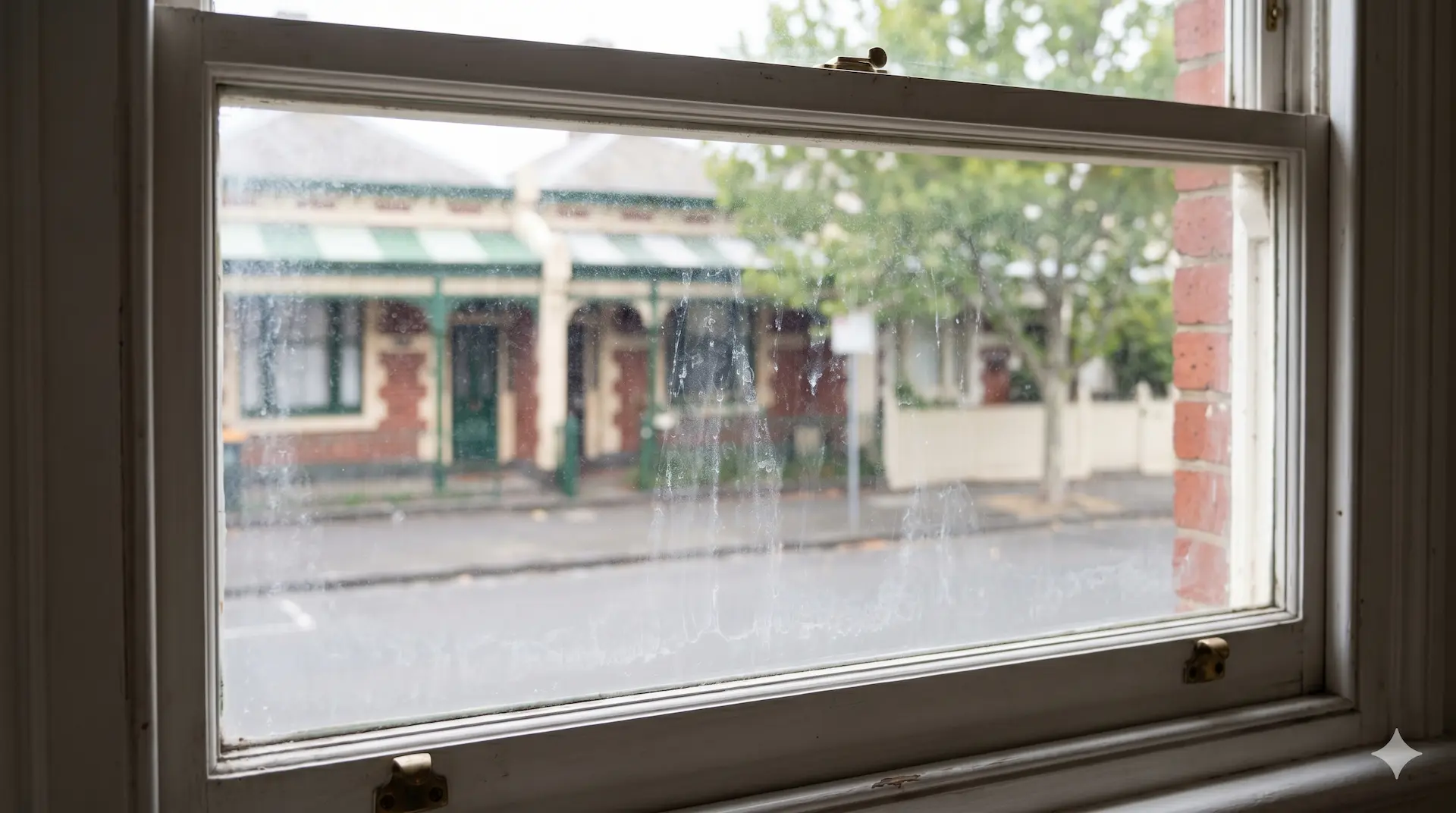
Hard Water Stain Removal for Melbourne Heritage Windows
Hard water stains on heritage glass are not the same problem as hard water stains on modern windows, and the treatment isn't the same either. Sash & Polish assesses staining on original glass before any treatment begins. Whether the deposit is reversible, how deeply it has etched, and what solutions are safe for the glass and any surrounding lead came all determine the approach. We'll give you an honest answer before we start.
Hard water stain removal scope
- Assessment of staining type and severity. Mineral deposit on the surface versus etching into the glass
- Treatment appropriate to the glass type. Original hand-poured glass, leadlight sections and modern replacement panes are treated differently
- Calcium, magnesium and silica deposit removal using solutions safe for heritage glass and lead came
- Honest report on sections where staining has etched permanently. We'll tell you before we treat, not after
- Follow-up advice on the conditions causing the staining and whether the source can be addressed
- Standard window clean completed after stain treatment to present the full result clearly
Why hard water staining behaves differently on original glass
Modern float glass has a uniform, smooth surface. Original hand-poured glass has microscopic variations in texture (undulations, thicker and thinner sections) that affect how deeply mineral deposits bond and how quickly they etch.
Hard water staining occurs when water containing dissolved calcium, magnesium or silica dries on glass and leaves a mineral residue. Common causes in the inner-east include bore water irrigation reaching glazing, roof runoff across leadlight fanlights, and older copper plumbing that carries a higher mineral load.
On original glass, the gap between a reversible deposit and a permanent etch can be shorter than on modern glass. Staining present for more than two seasons may have etched beyond full reversal. We assess before we treat, and we'll tell you which sections fall into which category before any chemical is applied.
Leadlight adds a further constraint. Many commercial stain removers contain acids that dissolve mineral deposits but also attack lead came. Treatment on leadlight panels requires solutions safe for both the glass and the metal.
What to expect
Get in touch and describe the staining
Where it is, how long it's been there if you know, whether there's a sprinkler or water source nearby, and whether the windows have any leadlight. A photo in direct light helps us understand the severity before we arrive.
We assess on-site before any treatment
We look at the staining in context: the glass type, the extent of the deposit, any signs of etching. We tell you what we expect to be reversible and what may not be, before any chemical is applied.
Treatment on the reversible sections
We work section by section, using solutions appropriate to the glass type. On leadlight panels, solutions are chosen for compatibility with lead came as well as glass.
Standard clean following treatment
Once stain treatment is complete, we clean the full window so you can assess the result clearly, without residue or treatment marks affecting the appearance.
Honest summary of the outcome
We tell you what was fully removed, what improved partially and what has etched permanently. If we recommend anything for preventing recurrence, we'll mention it.
Sash & Polish provides hard water stain removal for heritage windows across the suburbs above. Original glass and leadlight panels in this area are often irreplaceable, and the treatment they receive matters. If you're outside this area, it's worth a call, but we won't take work we can't do properly.
Common questions about hard water stain removal
Can all hard water stains on heritage glass be removed?
No. And any cleaner who tells you otherwise without assessing the glass first isn't giving you an honest answer. Staining that has been present for a long time on original glass can etch into the surface, at which point no cleaning treatment will fully restore clarity. We assess before we treat and tell you what's reversible before we begin.
What causes hard water staining on period homes?
The most common causes in Melbourne's inner-east are bore water irrigation systems where sprinkler heads angle close to glazing, roof and parapet runoff tracking across leadlight fanlights, and calcium-heavy tap water in homes with older copper plumbing. Identifying the source doesn't remove existing staining but may prevent it recurring on glass that's been treated.
Can you treat hard water staining on leadlight panels?
Yes, but the treatment is more constrained than on plain glass. Many commercial stain removers contain acids that dissolve mineral deposits but also damage lead came. We use solutions appropriate for both the glass and the came, and we explain the constraints before we start.
How is hard water staining different from a blown double-glazed seal?
Hard water staining is on the outer surface of the glass. It feels slightly rough to the touch and appears as a cloudy patch that moves when you clean around it. A blown seal causes fogging between the two panes of a double-glazed unit. It appears from inside the glass and cannot be cleaned away. If the haze looks trapped inside the glass rather than on the surface, it's a seal failure and requires a glazier. We'll tell you which you're dealing with when we assess.
Will the staining come back after treatment?
If the source of mineral-laden water reaching the glass is still present (a sprinkler, runoff path or leaking gutter) yes, it will recur over time. Treating the glass removes the existing deposit but doesn't change the conditions that caused it. We'll note any visible sources we observe during the job.
Not sure whether your staining is reversible?
We assess before we treat, and we'll give you an honest answer before any chemical is applied. Fill in the form with details about the staining and we'll come back to you.